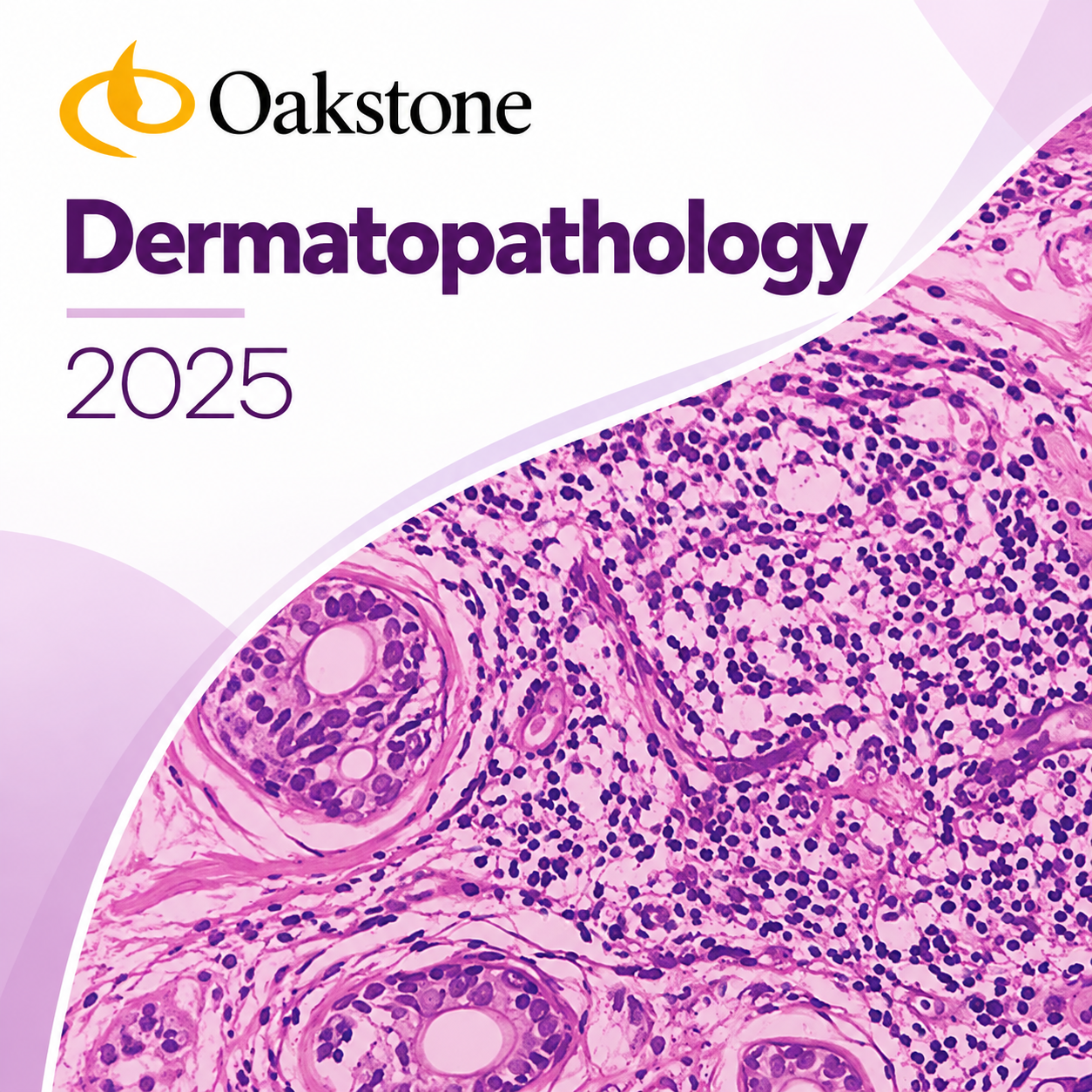
Oakstone Dermatopathology 2025
€90.00
The Oakstone dermatopathology 2025 series gives 15 case-led lectures from nine experts on inflammatory, haematolymphoid, adnexal, vascular and melanocytic skin pathology and the smart use of ancillary studies.
- 15 videos · 2 PDFs · released October 2025
- Sweet syndrome mimics, BPDCN, drug reactions & cutaneous emergencies
- Sebaceous & sweat gland tumours, melanoma reporting, Merkel cell update
- Instant access · unlimited access in time

Work through the skin biopsies most likely to mislead a pathologist
The Oakstone dermatopathology 2025 lectures use real cases and near misses to cover difficult dermatoses, cutaneous emergencies, drug reactions, histiocytoid Sweet syndrome, BPDCN, mesenchymal and vascular tumours, adnexal and sebaceous neoplasms, MiTF-driven lesions, melanoma reporting, melanocytic immunohistochemistry and Merkel cell carcinoma.
-
15video lectures
-
9expert faculty
-
2PDF documents
-
4.59 GBtotal size
The programme
Inflammatory dermatoses & urgent biopsies
May Chan opens with challenging inflammatory patterns and skin emergencies where a quick, accurate read changes management. Steve Billings follows with cutaneous reactions to modern systemic treatments.
Haematolymphoid mimics & hard-won lessons
Alexandra Hristov contrasts histiocytoid Sweet syndrome with its look-alikes and explains why blastic plasmacytoid dendritic cell neoplasm must not be missed. Ahmed Al-Omari shares what difficult cases and near misses have taught him.
Soft tissue & vascular tumours of the skin
Carina Dehner reviews superficial mesenchymal neoplasms, and Jason Hornick works through cutaneous vascular tumours. Both sessions emphasise how ancillary studies narrow a broad morphological differential.
Adnexal neoplasia in Oakstone dermatopathology 2025
Thibault Kervarrec applies IHC and molecular tools to adnexal tumours, while Katharina Wiedemeyer covers acral sweat gland lesions and sebaceous neoplasia criteria. Practical differential points help avoid common misclassification.
Melanocytic pathology & Merkel cell carcinoma
Klaus Busam presents reporting standards for primary cutaneous melanoma and the role of immunohistochemistry in melanocytic tumours. MiTF-activated neoplasms and an update on Merkel cell carcinoma complete the series.
Who it’s for
- Practising pathologists handle difficult skin biopsies with structured reasoning and ancillary tests
- Dermatopathologists update knowledge on emerging entities and reporting guidance
- Dermatologists understand what drives the pathologist’s differential and report wording
The consult
When was the programme released?
The original release date is 31 October 2025, as part of the Masters of Pathology series.
Is it more neoplastic or inflammatory?
Tumours take the larger share, but the opening lectures focus on inflammatory dermatoses, emergencies and drug reactions.
Does it explain ancillary testing?
Yes — guidance on immunohistochemistry, tissue culture and molecular studies runs through many of the talks, particularly the adnexal and melanocytic sessions.
What do the PDFs contain?
Two PDF files accompany the 15 videos; their exact content is not specified, so treat them as supporting material.
Can I begin immediately?
Yes — the lectures and PDFs become available as soon as the order is paid and never lapse.
Do I get CME credit or a certificate?
No. Derma Academy provides the course files only — no CME or CE credits, MOC points or certificates of completion are included.
The spec label
| Format | Video lecture series — 15 videos, 2 PDFs, 4.59 GB |
|---|---|
| Release | 31 October 2025 · Masters of Pathology series |
| Faculty | Klaus Busam · Jason Hornick · May Chan · Steve Billings · five more |
| Level | Practising pathologists & dermatopathologists |
| Topics | Inflammatory dermatoses · adnexal tumours · melanocytic lesions · Merkel cell carcinoma |
| Training models | Case-based lectures · histology images |
| Discipline | Dermatology · Dermatopathology |
| Delivery | Instant access · unlimited access in time |
Related products