Hands‑On Open Rhinoplasty Masterclass: Achieving Subtle, Primary Hybrid Results for a Naturally Refined Nose

Original price was: €210.00.€69.99Current price is: €69.99.
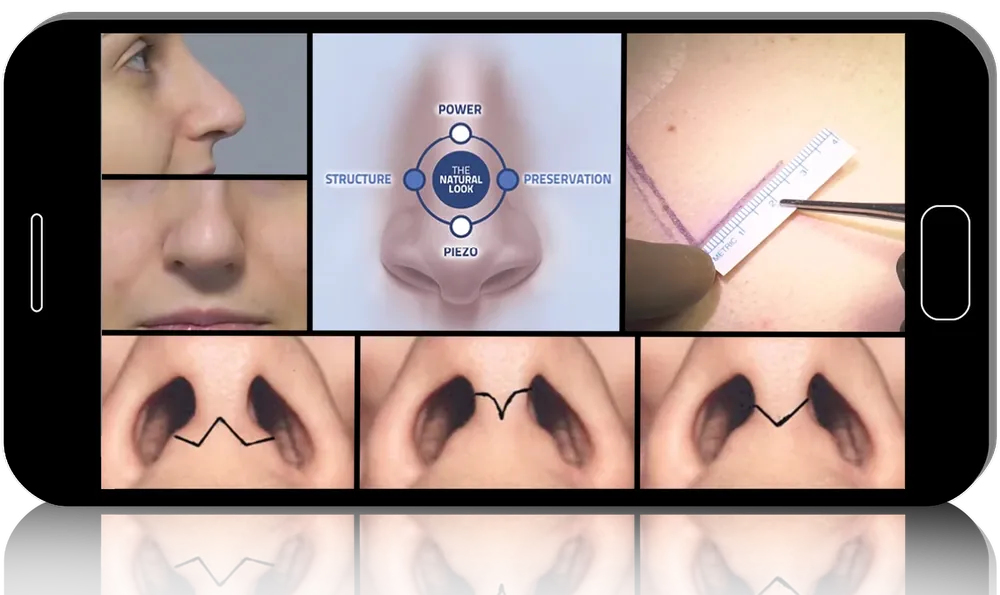
The hybrid rhinoplasty course shows Enrico Robotti performing six full-length open operations that merge dorsal preservation with structural tip work and combined piezo and powered bone shaping.
- Modified dorsal split, push-down & asymmetric let-down variations
- Septal fusion sling, three-point compartmentalization & piezo turbinoplasty
- Composite conchal graft, intraoral chin implant & rib SPLF revision
- Instant access · unlimited access in time

A short look inside — full masterclass unlocked at checkout.
Combine preservation and structure for natural primary noses
The hybrid rhinoplasty course records Enrico Robotti’s open operations from first incision to closure — modified dorsal split, high- and low-strip push-down and let-down, piezo plus powered osteoplasty, septal fusion sling, three-point compartmentalization and piezo turbinoplasty — across five primary noses and a bonus rib-graft revision for saddle deformity.
-
6complete cases
-
21hlisted surgery
-
1operating surgeon
-
Unlimitedcourse access
The programme
Dorsal preservation with a modified split
Each primary case adapts the dorsal split differently: high-strip push-down with overlap, conservative low-strip let-down, and markedly asymmetric let-down for deviated noses. Exposure follows subperichondrial and subperiosteal planes to protect the soft-tissue envelope.
Piezo and power tools in the hybrid rhinoplasty course
Robotti uses ultrasonic and rotary instruments together for osteoplasty and osteotomy in every case, explaining which tool suits each task. Turbinate reduction is performed with his piezo turbinoplasty to protect the airway.
Tip structure and ligament repair
Tip work combines lateral crural steal, lower lateral cartilage turn-under or slide-under, septal extension grafts and spacer struts. Ligamentous support is restored and the result secured with sublaminar septal dissection, a fusion sling and three-point compartmentalization sutures.
Complex anatomy and composite grafting
A nearly five-hour case treats a young man left with deformity after childhood neurofibroma excision, blending primary and revision strategies. Perichondrial–periosteal flaps, bilateral spreaders and a conchal composite graft for a retracted ala feature prominently.
Chin balance and rib revision
One patient also receives an anatomic silicone chin implant through an intraoral pocket. The bonus revision harvests rib, rebuilds the L-strut with layered grafts and augments a saddle dorsum with Robotti’s SPLF graft and rib plaster.
Who it’s for
- Rhinoplasty surgeons see how preservation and structural steps are blended within one operation
- Facial plastic surgeons adopt combined piezo and powered bone work for osteoplasty
- ENT surgeons link septoplasty and turbinate reduction to aesthetic tip and dorsum refinement
- Surgeons facing revisions follow rib-based L-strut reconstruction for saddle deformity
The consult
Are the operations shown in full?
Yes — each case runs roughly three to almost five hours, so you see the complete operative sequence rather than highlights.
Is every patient a primary rhinoplasty?
Five cases are first-time operations, although one involves deformity from earlier tumour removal. The sixth, a bonus, is a secondary procedure using costal cartilage.
Does it address breathing as well as appearance?
Yes — functional septoplasty and piezo-assisted turbinoplasty appear throughout, and several patients present with significant airway obstruction or deviation.
Can a less experienced surgeon follow it?
The series is pitched at all levels, but it is detailed operative footage. Treat it as observation that complements, never substitutes for, supervised surgical training.
How do I get into the videos?
Your access switches on right after checkout, and there is no deadline for finishing the cases.
Do I get CME credit or a certificate?
No. Derma Academy provides the course files only — no CME or CE credits, MOC points or certificates of completion are included.
The spec label
| Format | Operating-room video series — 6 cases |
|---|---|
| Listed duration | Around 21 hours of surgery |
| Faculty | Enrico Robotti |
| Level | All levels, from developing to experienced rhinoplasty surgeons |
| Techniques | Dorsal split · let-down · piezo osteoplasty · fusion sling · SPLF graft |
| Training models | Live open surgery with surgeon commentary |
| Discipline | Plastic Surgery · Rhinoplasty |
| Delivery | Instant access · unlimited access in time |
| Author | Enrico Robotty |
|---|
Related products
Facial Rejuvenation
Niamtu Platinum Deluxe Full Series Compilation — Complete Facial Aesthetic Surgery Mastery
Plastic Surgery

Plastic Surgery
Academies / Programs