ASLMS Fundamentals and Laser Safety: Core Principles for Clinical Applications On-Demand Course 2025
Original price was: €810.00.€60.99Current price is: €60.99.
The laser safety fundamentals course brings ten ASLMS speakers together to cover tissue interaction, device choice, treatment endpoints and safe protocols across the most common dermatologic laser indications.
- Laser physics, safety, tattoo, pigment & vascular lesions
- Resurfacing, tightening, scars, drug delivery, hair & acne
- Skin of color, complications & combination pearls · PDFs
- Instant access · unlimited access in time

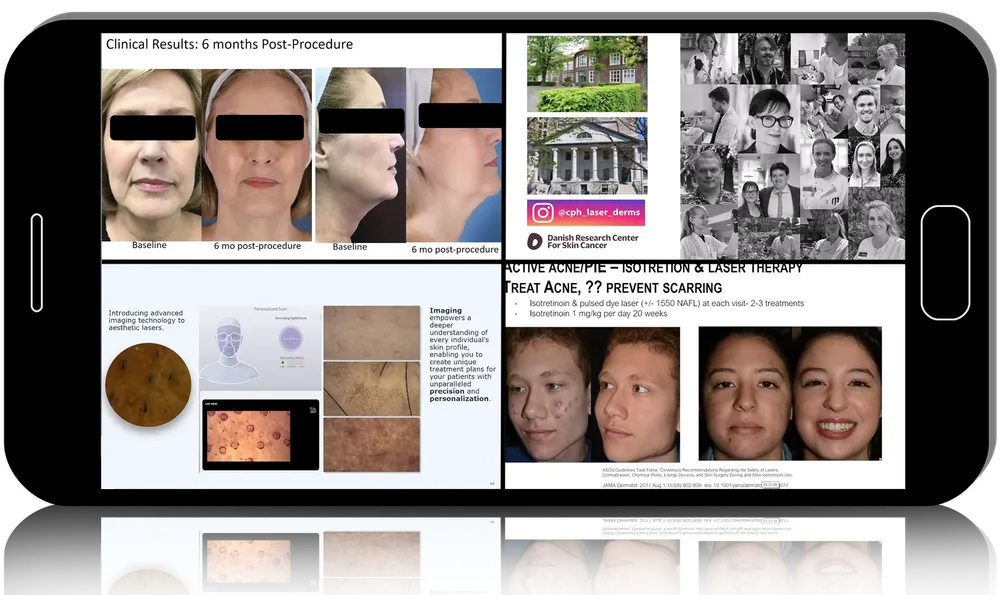
A short look inside — full masterclass unlocked at checkout.
Match laser, wavelength and endpoint to each skin indication safely
The laser safety fundamentals course recorded by ASLMS faculty moves from laser-tissue physics and device selection to tattoo, pigment and vascular work, non-ablative resurfacing and tightening, scar treatment, laser-assisted drug delivery, hair and acne protocols, clinical endpoints, combination therapy, skin of color and complication management.
-
4lecture blocks
-
6h 55mlisted teaching
-
10faculty speakers
-
Unlimitedcourse access
The programme
Laser physics & technology choice
The first block explains how light interacts with tissue and how laser types and parameters differ. That foundation is then applied to choosing the right device for a given condition rather than relying on a single platform.
Tattoos, pigmented lesions & vascular targets
Speakers translate the physics into tattoo removal, treatment of pigmented lesions and vascular lesion therapy. Parameter choices and skin response are discussed so that clinicians can relate settings to what they see on the patient.
Protocols in the laser safety fundamentals course
A dedicated safety segment opens the second block, setting out protective practices for both operator and patient. The same block covers non-ablative resurfacing and tightening, laser scar revision and drug delivery assisted by fractional devices.
Endpoints, follicular indications & combinations
The third block teaches how to recognise therapeutic and warning endpoints during treatment. It then applies lasers to hair removal and acne before discussing how combined modalities may be sequenced for better overall results.
Skin of color, complications & practical pearls
The closing lectures address safer treatment of darker skin types, recognising and managing laser complications and practical tips for frequent conditions. Diagnosis and planning for varied patient populations tie the session together.
Who it’s for
- Dermatologists consolidate laser physics, endpoints and parameter selection
- Plastic surgeons add resurfacing, scar and pigment devices to their practice with safety in view
- Physicians from other specialties gain a structured grounding before using clinical lasers
- Engineers and laser researchers see how device principles translate into patient care
The consult
Why are there only four lessons?
Each lesson is a block of several talks recorded back to back, so files run from roughly 80 minutes to over two hours without shorter chapters in between.
Do I need a physics background?
A basic grasp of skin biology and physics helps you get the most from the talks, though the opening block starts from core principles.
Are written materials included?
Yes — PDFs accompany the four lecture blocks.
Is hands-on device training part of the course?
No — it is a recorded lecture programme and does not replace supervised training or local laser-safety requirements.
How do I start after purchase?
The lectures and PDFs become available immediately after payment and stay accessible without a time limit.
Do I get CME credit or a certificate?
No. Derma Academy provides the course files only — no CME or CE credits, MOC points or certificates of completion are included.
The spec label
| Format | Online lecture course — 4 lessons plus PDFs |
|---|---|
| Listed duration | 6 hours 55 minutes |
| Faculty | Kelly Stankiewicz · Omar A. Ibrahimi · Jill S. Waibel · seven more |
| Level | Foundational to intermediate clinical laser users |
| Techniques | Tattoo · pigment · vascular · resurfacing · scars · hair · acne |
| Training models | Recorded society lectures · PDFs |
| Discipline | Plastic Surgery · Laser Medicine |
| Delivery | Instant access · unlimited access in time |
| Author | Kelly Stankiewicz, Sungat K. Grewal, Zeina S. Tannous, Fernanda H. Sakamoto, Omar A. Ibrahimi, Jill S. Waibel, Merete Haedersdal, Molly Wanner, Christine C. Dierickx, Patricia M. Richey |
|---|
Related products
Aesthetic Medicine
Aesthetic Medicine